
I’ve heard good things about the Peacock reality competition The Traitors since its debut. Alan Cumming has long been one of my favorite actors (his performance as the Emcee in the 1998 Broadway revival of Cabaret, which I first saw on The Rosie O’Donnell Show, is one of the siren songs that drew me to New York). And he has certainly earned his two Best Host Emmys, which he won after an eight-year reign in the category by the Queen herself, RuPaul (I have thoughts about that show too).
This is the first season, however, that I’ve really made a concerted effort to follow it—and it has not disappointed. While the casting suggests a jobs program for out-of-work reality TV stars and sundry C-list celebrities, we shouldn’t underestimate just how many Americans belong to that class. This season, the producers have concocted the perfect brew of Housewives, gamers, athletes, and individuals with notable personality disorders.
Whether it’s Michael Rappaport shoveling ravioli into his mouth between diatribes on the fairness of shield distribution, Rob the snake handler making everyone swoon with his slutty overalls, or Lisa Rinna overperforming at breakfast (she’s not what you’d call a subtle actor, but she can dazzle you with pyrotechnics), it’s great TV and always leaves you wanting more.
But I’ve also been struck by the deep philosophical questions running beneath this reality game show. Every roundtable elimination and group challenge is a test of the stability of a civil society. Can the “faithfuls,” who outnumber the “traitors” five to one, successfully organize to root out the murderers in their midst? Or will they be derailed by factionalism, personal animosity, ambition, and greed? It’s a question not just for the white hats, but the traitors themselves, especially after Rob’s bold decision to select his co-conspirator, Lisa Rinna, for elimination at the last roundtable. He still hasn’t given a compelling explanation for that, and he’s playing a dangerous game as the only man in the turret with two Real Housewives.
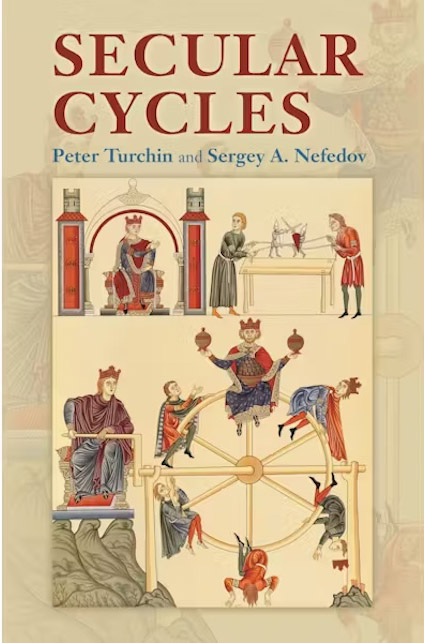
I wonder if Professor Peter Turchin is a fan. Turchin is a pioneer in the field of Cliodynamics, which employs big data to discern patterns in human history. In his excellent books, Secular Cycles and End Times, he lays out a compelling theory for the seasonal nature of civilization: A society with a small but unified elite oversees tremendous growth, which leads to an expanded elite (made up of the children of incumbents, but also clever newcomers). To be noticed in the crowd, they engage in ever more ostentatious displays of wealth, which must be supported by an increasingly squeezed working class. Aristocratic competition intensifies at precisely the moment when the commoners become resentful, leading to a tinderbox. Once the elites begin turning on one another, you can be sure that a societal crisis (or even collapse) is not far behind.
The Traitors seems to be mostly a test of one’s ability to navigate palace intrigue: Whom do you trust? Whom can you persuade? How do you survive a period of intense paranoia without drawing too much attention to yourself (but also without appearing suspiciously silent)?
In that regard, it’s the perfect game for America’s rococo period, with the role of the court played by the precariat of American celebrity (so many of their outfits would have turned heads at Versailles). For every Talleyrand there are a dozen Philippe Égalités, noisy talking heads destined for a wicker basket (or, in the lower-stakes television simulation, a spotlight on Alan’s “circle of truth,” where all banished contestants must ultimately reveal themselves). Only the most cunning survive. This is how the ruling class culls the herd and reconstitutes itself for the next cycle.
Anyway, I’m quite looking forward to seeing how this game plays out, especially with the war between Lisa Rinna and Colton Underwood officially declared. In a struggle between gays and housewives, my money is on the sexy snake handler, who seems to me a shrewder political operator than the backwoods Alabama boy he plays on TV.