
Gay men are the vanguard of consumer culture. It’s not just our fondness for fine goods and expensive vacations, the luxury tastemaking that filters down from the A-gays to the bargain bin of the straight world like so many cerulean sweaters. It’s also our willingness to abandon the old bonds of kinship, to sever ties with our biological families and create new tribes, or “chosen families.” We like to couch this in the language of liberation, and for those who grew up in homophobic families, it often is liberatory. But we rarely reckon with the way choice informs our behavior, how the very act of choosing suggests that these rainbow-tinted ties are temporary—especially when so many other consumer goods are disposable.
Pillion, Harry Lighton’s recently released film about a BDSM relationship between two men, exposes this truth with brutal honesty. The title refers to a passenger saddle on a motorcycle. It is an accessory should you want someone to ride along with you; but it’s not strictly necessary.
While much of the copy-paste entertainment press has falsely labeled the film a “rom-com” and reflexively hailed it for its “sex positivity,” I saw a Kevlar-clad reflection of the artfully rebranded master-slave dynamics that presently exist under the total victory of liberal capitalism.
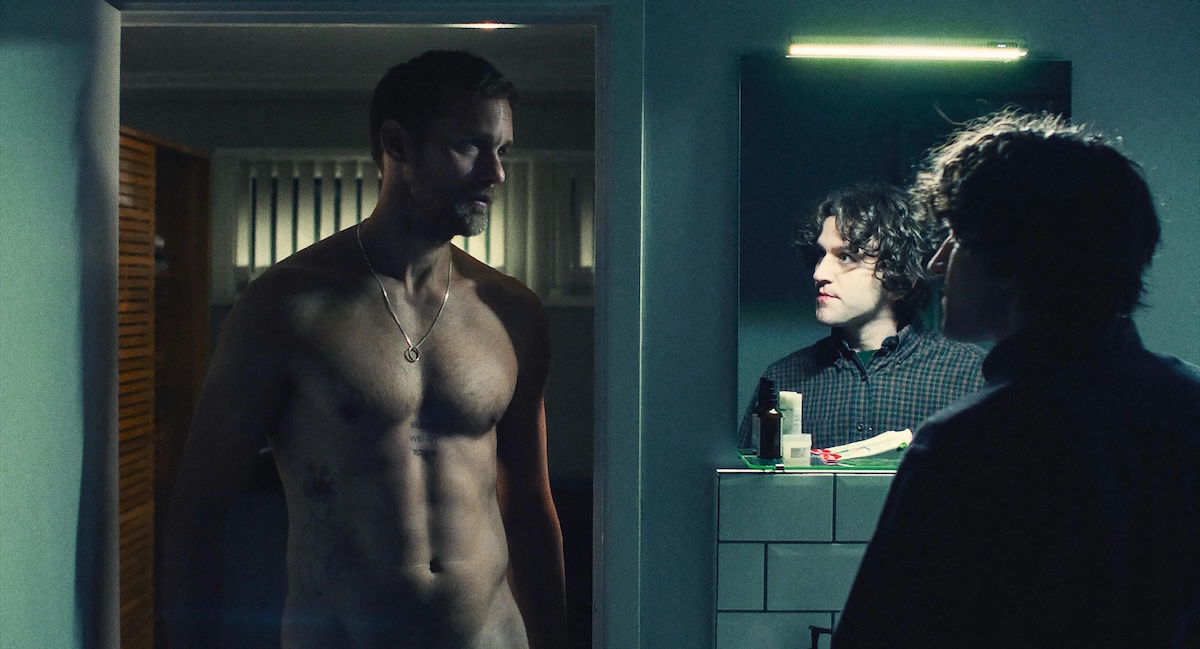
The film follows nice little gay Englishman Colin (Harry Melling, all grown up from his days as Dudley Dursley in the Harry Potter franchise) through his sexual awakening after he catches the eye of a broodingly handsome biker named Ray (Alexander Skarsgård).
As is often the case with the gays, sex comes first, with Colin blowing Ray in an alleyway on Christmas Day. Ray knows he’s hooked a real submissive when Colin accedes to this request. He also knows that Colin will agree without question to cooking him dinner the first time he comes to his Ray’s home. Colin is later invited to sleep on Ray’s rug (he’s not welcome in the bed). And he wakes to find a “to do” list Ray has left him. If Colin completes all his chores, he gets dick—always in the manner of Ray’s choosing, of course. Colin is less a boyfriend than a personal assistant with benefits.

Colin not only consents to all of this, he relishes it. We know this from the stiff dick print in his wrestling singlet after he and Ray tussle around in the living room. He clearly sees sexual servitude to Ray as preferable to the boner-shrinking alternative, slaving away as a parking attendant and living with his parents. With his don’t-notice-me posture and crooked smile, Melling perfectly embodies the best little boy in the world who, lacking wealth and conventional good looks, compensates with his penchant to please. He delivers service with a smile, and it’s very easy to smile when you’re servicing Alexander Skarsgård’s big veiny cock.
Scandinavian, stoic, and unimpeachably masculine, Skarsgård is the fantasy of every self-loathing homosexual. He conveys so much with so few words, and that’s a good thing, because Lighton has written little for him to say (conversation is so femme). We never figure out where Ray is from, what he does for a living (I suspect something in the knowledge economy by the way he scrolls his phone), or who his people are. One of the only indications we get of a personality beyond his carefully cultivated sexual image comes in a shot of him lying in bed reading Karl Ove Knausgård’s pretentious autobiography, My Struggle, an appropriately on-brand literary choice.
Ray is the ultimate atomized consumer: He knows his value in the marketplace (very high), he knows what he wants (a slave), and he gets one. And while he refuses to kiss Colin on the lips, he does buy him some very expensive biker gear, which is the closest one can get to “I love you” when all human affection must be expressed through retail.

Let’s not forget the vacations: Colin accompanies Ray to a bikers’ camping retreat, offering us an inside look at this ultra-masc sexual subculture. When Colin fails to knock over his opponent in a chicken fight, Ray grows frustrated and asks another dom to borrow his boy Kevin (Jake Shears of the Scissor Sisters exemplifying the unbridled gay imagination: you can be 47 and still be a boy). Later, as Kevin and Colin are moving a table on which to spread out the bottoms like a barbecue buffet, Kevin remarks on how impossibly attractive Ray is. “And you…it must be hard being with a guy who doesn’t kiss, huh?” Dress it up in as much leather and as many dog collars you want, it’s still the same old fag drama everywhere you go.
Pillion reminded me of what a terrible sub I would be. Throughout much of the film, the voices of my Scotch-Irish ancestors howled through my brain, “Cook your own dinner you lazy Swedish cunt!”
That same spirit surely animates the English working class, here best embodied by Colin’s mother. Dying of cancer and acutely attuned to what really matters, she wants to know that her son is with a good man. She insists Ray join them for dinner, an invitation he begrudgingly accepts after some cajoling (Colin asks nicely from over Ray’s shoulder as he mournfully plays Satie on his keyboard, another slim indication of a personality). When Ray makes a comment about how Colin can only really cook an omelet competently, she tells him, “I’m not sure I like the way you talk to my son,” correctly surmising that Colin is the woman in this situation and she would never tolerate a husband speaking about his wife this way.
Ray responds by attempting to paint her as a homophobe (this is the same woman who insisted on meeting him) and calling her “ignorant” — the weary battle cry of an exhausted liberalism that has long since devolved into libertinism, in which the most obscene imbalances of power are wrapped in a rainbow flag and passed off as progress.
Scratch beneath the surface of any sex-positive kink community comprised entirely of men and you’re likely to discover power dynamics rarely found outside of certain fundamentalist Mormon sects or the Persian Gulf: the two-person marriage transformed into a throuple with the begrudging acceptance of the primary husband; or the middle-aged alpha who rules over a veritable pound of pups like it’s his personal harem. These situations almost always involve a high-status man at the center, bending the lives of poorer men to his will. In America, money buys the dream.

Sometimes, as was the case in the Noodles and Beef Cult, it’s clear that the alpha is purposely preying upon the mentally ill and terminally insecure. It’s all branded as “play,” but none of us exist outside the context of class and capital, and when your dom is paying your rent, playtime never really ends—at least for him. In many ways, kinky gay men who openly describe themselves as “masters” and “slaves” are just being honest about the way the world really works: exploitation, yes, but always with consent.
Because that is the great con of liberalism in the 21st century: convincing the people that we agreed to our misery. We consented to the terms and conditions that allow big tech platforms to spy on us, mine our data, and sell it to the highest bidder. We consented to the democratically-elected government fleecing Americans with tariffs and shooting citizens in the streets. We consented to work our shitty jobs, just like the desperately poor women Jeffrey Epstein hired to massage him consented to be there. “Don’t like it? You can always walk away and find something better,” say the people who are currently plotting to replace most jobs with AI and robots, forcing the rest of us into a permanent state of precarity. The rich and powerful always have options while the rest of us just have obligations.
(SPOILER ALERT) Once Colin finally starts to speak up for his needs, to ask for one day off a week in which he and Ray can behave as boyfriends and equals, Ray allows for one date as a trial, realizes he cannot handle this level of real intimacy, and bolts. He ghosts Colin and moves out of his apartment, never to be seen again. It is a most cowardly look for a dom, but unsurprising coming from a gay culture that has grown accustomed to the cold convenience of the Grindr block feature. If someone makes you unhappy, you can just make them disappear like a worn-out pillion that no longer has any use in your life.
Why bother compromising with another person, sacrificing some of your desires for their needs, when you might still find that slave who truly never turns off, whose entire life revolves only around you? The sex bots will hit the market any day now, and until then, you can keep shopping, not for lovers or partners, but human accessories to your perfectly self-centered lifestyle. This is how the consumer economy dehumanizes and turns us all into vampires, craving gratification over real human connection.
Lighton should be commended for depicting this with clear-eyed honesty. There is no “happily ever after” in Pillion. It is most certainly not a “rom-com.” But it is an accurate depiction of where gay men are in 2026, and where the laggard straights are soon to find themselves too.